Vietnamese Swords
By Scott M. Rodell
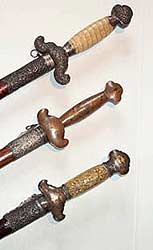 |
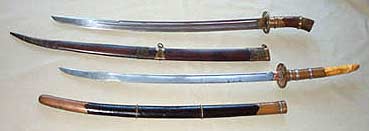
Nineteenth Century
Vietnamese Kiem,
Private Collection
|
Swords of Vietnam are a beautiful and interesting cross
of Chinese, Japanese, Thai and in later designs, French influences.
Vietnamese smiths employed sophisticated methods of inlaying precious
metals and excellent chased silver for the fittings of their weapons
that are unique to the region. Finer examples of both types of swords
are often mounted with ivory elephant handles. These grips are either
made of the tip of an tusk elephant or of sections of elephant molars.
The kiem is a double edged straight sword that
has no parallel elsewhere in Southeast Asia. Kiem are clearly a direct
descendant of the Chinese straight sword, or Jian, and mirror
their general shape and design very closely. The Vietnamese kiem
however are lighter with thin almost needle-like blades. In some respects
the Vietnamese straight sword is reminiscent of European small swords
and at first glance one might mistakenly assume a European origin for
this weapon.
The Vietnamese saber, dao, can be found in three
varieties. Each originating from one of the three foreign influences
mentioned above. From the 1400's to the 1800's, saber forms followed
the political divisions of the country. Sabers from northern Vietnam
(Tonkin) show a strong Chinese influence. In blade form and design of
fittings, they descend from the Ming type LiuYe Dao - 'Willow
Leaf Saber'. These dao have a hand or hand and a half grip.
| |
| Nineteenth Century Vietnamese
Tonkin (upper)
and Cochin sabers,
Private Collection |
Dao of Cochin China are of the two handed variety
called dai dao. These are related to other Southeast Asian saber
such as the Burmese and Thai dha. But they also show a strong
Japanese influence. It is interesting to try and derive from where this
Japanese influence derives.
There has been a Japanese presence in Thailand and coastal
Vietnam beginning in the 15th or 16th century. In Thailand, they served
as mercenaries and it is likely that they fell into piracy as they did
in other areas of Asia. In their roles as soldiers or brigands, Vietnamese
would certainly have come in contact with weapons of Japanese origin.
| |
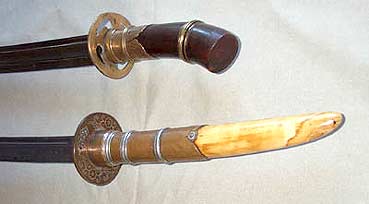
| Detail of Tonkin (upper) and
Cochin saber hilts. |
The Japanese influence on Vietnamese dai dao
appears strongest in the fittings. These Cochin sabers have guards shaped
like the tsuba of Japanese katana. Some are actually copies
of tsuba right down to the holes on either side to allow for
the utility knives present on the side of Japanese sword scabbards (but
are absent on the dai dao). The Cochin dai dao also have
a habaki or collar at the forte as do Japanese swords. Sometimes,
oval, serrated washers like Jappanese seppa are also positioned
between guard and collar.
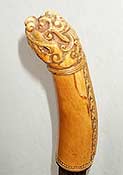 |
18th
Century
Vietnamese
Saber Handle
of Carved Ivory,
Private Collection
|
While these specific features are drawn from Japanese
sources, the overall design of the Cochin saber is Southeast Asian.
Their blades form closely follow the Chinese Willow Leaf pattern mentioned
above. And the grips on these weapons are also of round cross-section,
like those of Thai and Burmese dha. It should also be noted that the
Vietnamese sometimes utilized foreign blades. One example in the Metropolitan
Museum of Art's collection in New York has a Japanese blade. Later
kiem and dao were also made with French blades.
The native forged blades of Vietnam are pattern welded
steel. These blades are forged by a Chinese method known as qiangang
- 'inserted steel'. This type of blade construction employs an inserted
hardened steel cutting edge backed by a soft steel core. These two components
are sandwiched in layered damascus steel. Some examples of parade swords
have blades of copper or brass. It is an open question as to why a sword
would be made with a non-functional blade. I can only suggest at this
time that they were made for use in close proximity to the Annam emperor
to prevent their use in an assassination attempt. By the later 1890's,
one French traveler noted that the quality of blades had declined.
| |
|
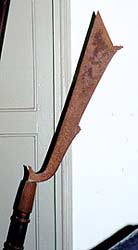
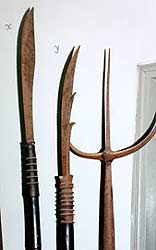
| Polearms Mitiary
Museum Vietnam |
| Vietnamese Weapons Terminology |
| Cung:
bow
Kiem*: straight sword
Dao†: saber
Dai-dao††: two-handed saber
Doan-dao††: dagger
* Jian in Mandarin
† The small "d" should be crossed
†† The small "d" should be crossed
In Vietnamese, the D is pronounced like
an English "d". A crossed D is pronounced like "z" in the north,
like "y" in the south. |
In the early nineteenth century another foreign influence
affected Vietnamese dao - France. After the French bankrolled
the establishment of the Nguyen dynasty in 1802, lion-head pommels began
appearing. These sabers are essentially European in design, with 'D'
shaded knucklebows. This French pattern is overlaid and decorated in
the local Vietnamese fashion, usually with embossed silver fittings
on the scabbard and hilt and mother of pearl inlay in lacquer or rose
wood scabbards. Other examples have plain tortoise shell covered scabbards.
This style of saber has a scabbard chape with an usually sharp upward
accelerating curve terminating in a sharp end. This is quite different
from sabers of European design which tend to have chapes with rounded
ends. This pointed chape is most likely a hold-over from Ming Chinese
influences.
Vietnam, lying like a dragon along the coast between
the Chinese Empire and seafaring nations of Asia and Europe, has been
a melting pot of cultures for over millenium. The centuries of development
and varying cultural influences combine with excellent local craftsmanship
to produce unique swords of great beauty. Today these overlooked treasures
waiting to be discovered by collectors and students of antique arms.
© 1999 Scott M. Rodell
Reproduced here with permission
About the Author:
Scott M. Rodell is Director of the Great
River Taoist Center and owner of Seven
Stars Trading Co.. Rodell has over 20 years of experience
in Taiji Quan. He is a disciple student of Master Wang Yen-nien of
Shanxi province and also studied sword and push hands with T.T. Liang
and push hands and sanshou with William C.C. Chen. Rodell has been
teaching at Great River branches in Northern Europe since '91 and
was awarded 'Honored Judge' rank by the Russia Wushu Federation (their
highest rank).He is author of "Taiji Notebook for Martial Artists
and "Chinese Swordsmanship in the Yang Family Taiji Jian Tradition"
(Fall '01). He is also Moderator of the Chinese Swords & Swordsmanship
Discussion Forum at SwordForum.com.