Teaching Karate-Do
Interview with Kaicho Tadashi Nakamura,
founder and Chairman of the World Seido Karate Organization
By Christopher Caile
Nakamura still speaks with somewhat of a Japanese
accent. His use of words and sentence structure in
this interview has been retained as much as possible
to give a better sense of the person and flavor of
his speech.
Caile: Do you think with the rise in popularity
of karate that karate-do is still understood and taught
today?
Nakamura: What I would like to say is that
modern karate is now quite popular compared to the
past. There are more people studying karate, more
people teaching and more schools compared to before,
not only in America but in Japan and elsewhere too.
One good thing is that now people have more places
to study karate. But, at the same time, I'm a little
afraid of the kind of quality of teaching. Something
is missing. The spiritual and mental aspect is getting
less and less. This has happened as karate has become
more popular and taught in more and more places. People
are just taking karate as a kind of exercise, for
self-defense, as a type of aerobic exercise that is
also good for a diet. Others just see a flashy way,
or way that looks good, but the mental spiritual aspect
is getting less which I think now is a very dangerous
situation. This means that while there are now many
karate dojos, or schools, available, the instructors,
what we call shidosha or sensei, are teaching only
karate, but not karate-do. This is the big difference
compared to the past.
My experience is that karate should be for, not just
how to fight or defend yourself, but it should also
be more rounded to include mental and spiritual aspects.
Particularly what we call traditional karate should
include physical, mental, and the spiritual. They
should be well balanced but right now, even though
there are many instructors available, they are teaching
only how to kick and punch and missing "do." Now since
modern karate, also more emphasis on competition and
tournaments. Result is people always more pay attention
to who is going to be grand champion, or who is going
to fight who and say, "maybe he is going to win" or
"she is going to win" -- a kind of game is only concern.
Just only who is strong physically, who is strongest.
People are paying most attention to the way people
compete.
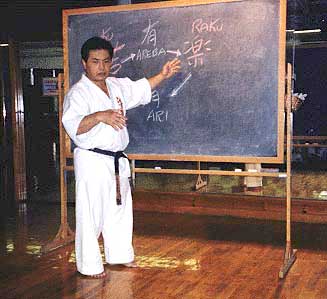
Nakamura lectures his students on karate-do
and other subjects in one of his weekly meditation
classes.
|
Caile: So how do you teach karate-do versus
regular karate and what do you emphasize?
Nakamura: So the way we call dojo, it means
a place you find out about yourself, place you find
enlightenment, place you find your way, your sincere
way. It's not a gym, club, a place of socializing
or getting a date, but place to study own self, to
learn techniques but also gain spiritual and mental
knowledge. I hope each student studies karate, their
dojo is also like a second home. Each time you come
you feel so comfortable, but also appreciate and feel
more serious too, similar feeling to when you go to
church, or when you go to special ceremony place.
You feel like, kind of dignity.
It's also very important, the way as teacher to make
a good program, what we call curriculum - it means
the way you study. You have to make sure you have
a good system. Each level has a certain amount of
material a person has to learn, step by step, instead
of all right way. In some systems right away after
you a little bit understand basics, you begin fighting.
The dojo is not just to produce fighters. The karate
dojo is not like a factory for producing strong fighters.
This way so often people get injured, they get discouraged
or uncomfortable, then discontinue training. That's
why it's very important, way you set up the system
the proper way so people continue. Then everyone can
benefit.
Karate is not just fighting but also how you control
your mind, which is your temper, your discipline and
your morals. We request student have to take meditation
class. At end I give a simple lecture about karate-do
attitude, spirit, practice or way to live. In these
classes students learn and have a better chance to
understand themselves, to look at themselves, more
inside and see what they are, what is missing, and
reflect also on other people. Maybe they realize,
"I'm still immature and that I have to grow and to
continue to polish myself." As a teacher I am concerned
individually because each student is physically and
mentally different. Conditions not exactly same for
everybody, and some physically not well. But karate
should be for everybody, so especially in Seido we
open to everybody, even mentally learning disabled
people, homeless children, deaf students, blind people
- there is room for everybody, even some domestic
violence situation people. Still they can study karate
to develop more inner strength to take care of your
life.

A
student taking a written exam as part of her
promotion. Students are asked to write short
essays explaining what they have learned, such
as: "Why do you study Seido Karate?"; Why do
we bow and say "OSU'"?; or for a discussion
of the meaning of a particular Japanese saying
or phrase.
|
So in the Seido system during promotions we ask students
to write down their thoughts on training, our organization
and philosophy, and what they have learned. At the
black belt level, students talk to other students
and teachers about essays they have written. We expect
their words to be genuine and sincere and to come
from their heart. We also stress etiquette, not just
in the dojo but extended to everyday life too. It
teaches respect of others, and it is also mental training
toward a way of the spirit. Those who have difficulty
with etiquette show their difficulties inside, maybe
ego, lack of self-respect or other problems. Courtesy
and manners require self-control, discipline and sensitivity
to others -- what is necessary to change one's self,
what is necessary to take control of one's life and
future.
Way I believe, to study karate-do is the way of your
life, but as karate-ka each karate-ka has responsibility
to be more open, to use whatever you learn from karate-do
to apply in your every day life - the way you control
your emotions, your temper, morals, discipline, how
you behave. To the extent you are using, you are becoming
more true karate-ka. That means a strong, true karate-ka
is not just how many tournaments you compete and how
many times you get to be champion, first place, or
grand champion. It is not. People think, "How many
times I have received Grand Champion, that's why I
am a great karate-ka." Sometimes people feel like
this. But how strong you are inside which means how
you dedicate your life, how you carry on your discipline,
that is important. That's why it is so important to
maintain and show discipline in the dojo. Especially
in Seido, we have so many different types of people,
handicapped people, learning disabled, all different,
but still those people seriously learn karate. Then
we all more realize and appreciate what we have and
how lucky we are.
Caile: What about spirit?
Nakamura: Through study of karate students
can develop a non-quitting spirit. It doesn't matter
if you are a woman, your sex or age, but as long as
you study karate you can develop a strong spirit,
a non-quit spirit. This because throughout our life
there is always something happening, but each time
something happens you take it as a challenge, and
even if you fall down you take it as your challenge.
You say, "This is a way I can grow. This way that
I can enrich myself." Then with positive attitude,
can face problems, can face obstacles. You can kind
of fight back. You develop an attitude as how to carry
on and live life. A good punch is fine. A good kick
is fine. But what really is really important is your
strength inside. That is what allows to meet life's
challenges. That is what people respect -- how you
dedicate yourself, how you dedicate you life.
Caile: You mentioned before that karate-do
leads to enlightenment, what do you mean by enlightenment?
Nakamura: Yes, enlightenment, word has so much
of a big meaning. In a way, we don't realize the reality
of our daily life. Even with important things, we
don't pay attention. So, kind of funny -- when we
study hard and train hard in karate-do it sometimes,
kind of, hits you. "Why I so much complain and blame
people when the problem is the way I am inside." That
is a great thing, a great understanding. You can say
this is one type of enlightenment because you find
out where lots of problems really are. In yourself.
In my meditation class lectures I talk about old Japanese
saying: "It is easier to find thief in a mountain
than thief in your heart." When thief runs away to
a big mountain and somewhere hides, he is difficult
to find. There are hundreds and hundreds of acres,
caves and crevices. But really more difficult to find
thief in own mind. That thief takes from you, denies
something that is yours. That thief is our ego, something
that always tries to grow. It robs spiritual progress,
hinders learning and making of deep relationships.
Ego builds walls inside and tells us, we must protect
ourselves, or that we already know so we don't have
to listen. So easier to find thief in mountain than
ego in mind. It is true. We think we have no ego problems,
but as we cannot spot thief in mountain, may not see
ego in our own mind. So we must constantly guard against.
Caile: So what do you think about so many karate-ka
no longer wearing plain white uniforms that symbolized
"do" and instead using those that are multi-colored?
Nakamura: Sometimes people, too much commercialize.
They have different color uniforms, patches all over,
stripe all over, flashy-- but you know, its not how
you look, how you impress or enjoy the color. Pure
simplicity, that is such an important thing. That's
why our uniforms are white. The way we study karate,
each time we do kiai with strong punch, strong kick
--- There is an expression in Japanese, "Ichi Geki
Hissatsu," meaning, "To kill with one punch" It means
not really killing someone else, but killing own ego.
That's why important to have good etiquette and show
respect. It's not always easy but by doing we control
ego. It's important. Make sure your ego is little.
Make sure your ego cut. Make sure it not grow. Polish
self and help in dojo. Do little things, like helping
clean floor after class. This is still part of each
one's training. Respect yourself, respect others and
make sure dojo clean for people who come later. Help
dust off, polish, mirror clean, spotless if possible.
Make sure floor no dusty.
Caile: So in Japan, with so much emphasis on
competition and being strong, is real karate-do being
lost?
Nakamura: Still some people continue karate-do,
but unfortunately often more the opposite way with
people teaching only competition karate, but not karate-do.
More and more people, they extremely just concerned
with fighting aspects -- who is going to be strong,
who is champion, who will be next. It's too much becoming
like a game and less mental and spiritual. It's missing
karate-do. I'm not 100 percent against a tournament
or championship. It's OK. You can do it, but sometimes
people think karate equals tournament, karate equals
full contact, karate equals championship. Then if
you are not involved, don't compete or participate
in tournament, people think you are not a strong karate-ka,
or maybe you are not qualified as a good karate-ka.
Some people think like, "How many times did you compete,
did you compete all Japan tournament, or world tournament?.
If you did not compete -- "ahh, you must not be a
strong guy." You know, that's ridiculous way of judgment.
That's really missing karate-do. It doesn't matter
if you didn't get a place, that you didn't get the
grand champion. What matters is the way you dedicate
your training and study of karate-do and dedicate
yourself, how you help your community, how you contribute
to your country or society -- that's a big difference.
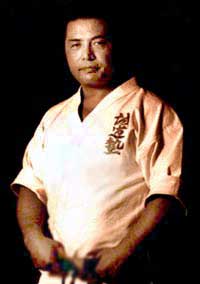
Kaicho Nakamura, 9th dan, was formerly the
top student of Kancho Masutatsu Oyama in the Japan
Kyokushinkai organization. Already a top Japanese
fighter he became internationally famous with his
1966 victory against the famous Thailand kick boxing
(Muay Tai) champion known as the "Green Tiger" as
part of a three member Kyokushinkai team that was
victorious over their Thailand challengers. Soon afterwards
he was made Chairman of the North American Kyokushinkai
Organization and traveled the world giving demonstrations,
clinics and seminars. Later he was awarded his seventh
dan in the organization. In 1976 Nakamura founded
and became Chairman of the World Seido Karate Organization
("Seido" meaning Sincere Way) and established the
Seido Juku headquarters in New York City. It has grown
into one of the largest and most respected dojos in
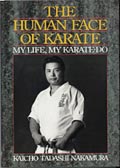
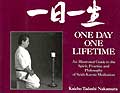
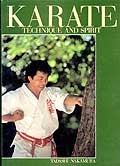
the city. He is the author of many books on karate
including Karate, Technique and Spirit, The Human
Face of Karate, and One Day, One Lifetime, An Illustrated
Guide to the Spirit, Practice and Philosophy of Seido
Karate Meditation. Nakamura's karate is noted for
its focus on teaching of the mental and spiritual
aspects of karate and for his belief that karate should
benefit everyone, not just the young and the strong.
In his dojos Nakamura stresses the importance of having
a feeling of family and sense of mutual support rather
than competition. This has not hindered the development
of top tournament fighters, however, with many become
national champions and grand champions. Unlike many
karate organizations Seido is also noted for both
the number of adult students (some still practicing
into their 70's) and women students . There are also
special teaching programs for the physically handicapped.
Nakamura, himself, projects a strong charismatic personality
and image that would be intimidating if it was not
punctuated by an engaging sense of humor and warmth.
He voices strong beliefs about karate and his organization
but also projects a genuine caring about his students.
As a leader he has engendered a fierce loyalty and
dedication among students. This has produced a base
of long-time seniors many who have followed him for
20, 30 or more years and helped his organization grow
worldwide.

back
to top
home
| about
us | magazine
| learning
| connections
| estore
|